
- Pain or crying during the passage of a stool (bowel movement or BM) OR
- Unable to pass a stool after straining or pushing longer than 10 minutes OR
- 3 or more days without a stool (Exception: Breastfed and over 1 month old)
Imitators of Constipation: Normal Variations
- If breastfed and over 1 month old: Infrequent stools every 4-7 days that are soft, large, and pain-free can be normal.
- Before 1-month-old, infrequent stools usually mean an inadequate intake of breastmilk.
- Grunting or straining while pushing out a stool is normal in young infants. (Reason: difficult to pass stool lying on back with no help from gravity) Infants commonly become red in the face during training.
- Brief straining or pushing for less than 10 minutes can occur occasionally at any age.
- Large stools – Size relates to the amount of food consumed and stool frequency. Large eaters have larger stools.
- Hard or dry stools are also normal if passed easily without excessive straining. Often relates to poor fiber intake. Some children even have small, dry rabbit-pellet-like stools.
Causes
- High milk or cheese diet
- Low fiber diet
- Postponing stools
- Slow intestinal transit time (genetic differences)
Normal Stools
- Once children are on a regular diet (age 1 year), the normal range for stools is 3 per day to 1 every 2 days.
- Every 4 and 5 days kids all have pain with the passage and prolonged straining.
- Every 3 days kids usually drift into longer intervals and then develop symptoms.
- Passing a stool should be fun, or at least free of discomfort.
- Any child with discomfort during stool passage or prolonged straining at least needs treatment with dietary changes.
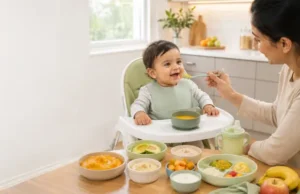
Diet for Infants Under 1 Year
- For infants over 1-month-old only on breast milk or formula, add fruit juices 1 ounce (30 ml) per month of age per day. Pear or apple juice is OK at any age. (Reason: treating a symptom)
- For infants over 4 months old, also add baby foods with high fiber content twice a day (peas, beans, apricots, prunes, peaches, pears, plums).
- If on finger foods, add cereal and small pieces of fresh fruit.
Diet for Children Over 1 Year Old
- Increase fruit juice (apple, pear, cherry, grape, prune) (note: citrus fruit juices are not helpful).
- Add fruits and vegetables high in fiber content (peas, beans, broccoli, bananas, apricots, peaches, pears, figs, prunes, dates) 3 or more times per day.
- Increase whole-grain foods (bran flakes, bran muffins, graham crackers, oatmeal, brown rice, and whole wheat bread. Popcorn can be used if over 4 years old.)
- Limit milk products (milk, ice cream, cheese, yogurt) to 3 servings per day.
Stop Toilet Training
- Temporarily put your child back in diapers or pull-ups.
- Reassure him that the poops won’t hurt when they come out.
- Praise him for the release of stools.
- Avoid any pressure, punishment, or power struggles about holding back poops, sitting on the potty, or resistance to training.
Sitting on the Toilet (if toilet trained)
- Establish a regular bowel pattern by sitting on the
- toilet for 10 minutes after meals, especially breakfast.
Warm Water for Rectal Pain
- Warmth helps many children relax the anal sphincter and release a stool. For prolonged straining, have your child sit in warm water or apply a warm wet cotton ball to the anus. Move it side to side to help relax the anus.
Flexed Position
- Help your baby by holding the knees against the chest to simulate squatting (the natural position for pushing out a stool). It’s difficult to have a stool while lying down.
- Gently pumping the lower abdomen may also help.
Call Your Doctor If: Constipation continues after making dietary changes your child becomes worse.